
Cancer
On the magic of the end

cw: animal illness, death
My brother and his dog were at the beach today, and it got me thinking about Venus entering Cancer.
Tess, the dog, is a Capricorn with three legs. Her fourth was removed to prevent the spread of cancer. The vets said that most dogs with this condition only get a single year more to live. But Tess has gotten two.
Cancer the illness and Cancer the zodiacal sign share a namesake: the Greek “karkínos” (Καρκίνος), crab. There are several accounts of why the Greek physician Hippocrates named the deadly illness after a simple crustacean, according to historian of medicine Howard Markel: “… if you examine a tumor, if you actually feel [a] malignant tumor, you'll note that it's hard as a rock. And so some have explained that it reminded [Hippocrates] of the hard shell of a crab. But others have said it may have reminded him of the pain that a malignant tumor induces. It's much like the sharp pinch of a crab's claw. And an even better version is that it suggests the tenacity with which, you know, a crab bites you...”
This last version of the story — the crab claw’s tenacity — evokes the disease’s notoriously unshakeable grip. While advances in medicine mean that more humans are surviving cancer than ever before, for loving companions like Tess, the most vets can hope to do is give a bit more time, even if on three legs.

My brother does not see himself as a spiritual person, but I think going to Dillon Beach on the Sonoma Coast has been a type of ritual for him. It’s where he took me to welcome me to California when I moved here in 2022. And now, it’s where he’s taking Tess in her latter days.
For Byung-Chul Han, an essential feature of ritual is repetition. A ritual is not something you do once. But this repetition is not the same as routine, which fades into the backdrop or normal activity. Ritualistic repetition is unique because it perpetuates that sacred energy of exception, creating time outside of time.
Anthropologist Shannon Lee Dawdy has written about how pets mediate our relationship with death, drawing on a pet cemetery in Chicago where votive offerings and grave decorations are refreshed more regularly than at any human cemetery she’s seen. (And she’s seen a lot of them over five years of research for her documentary on contemporary American death practices, I Like Dirt.)
Anthropologists have long been interested in how ritual mediates relations of the visible and invisible. While the descendants of ritual survive today through mass spectacles like concerts and sporting events, and calendrical constructs like civic holidays, I don’t believe any of these perform important spiritual functions for most people.
Ritual, like so many things today, seems to have become a personal matter. Flowers on the altar. Dog biscuits at the pet cemetery. A trip to the beach.
But maybe there is more to our private, personal rituals than meets the eye. Maybe we are participating in something greater, maybe even something eternal.

As the Moon met Venus yesterday and they passed into the sign of the Crab, my brother texted me from the beach: “I went to take Tess for our normal first walk for the day and she didn’t want to go. So we went to the beach and she was excited.”
Cancer is the 6th sign in my brother’s chart. The 6th house shows things to do with one’s pets, so I’ve been watching Jupiter there this year, and I’ve wondered what Venus joining him in the emotional water sign of Cancer might mean for Tess.
A novice might look at the Venus-Jupiter conjunction in my brother’s 6th house and say “what a great time for your dog’s health!” Certainly, it’s a good time to be making memories with Tess at the beach… But I wasn’t surprised to hear that her energy is faltering.
As students of astrology, we’re trained that Venus and Jupiter bring good things — joy and pleasure, meaning and purpose. But it’s not always as we expect. These benefic planets can be the main drivers in stories of loss — stories of release and letting go.
I’ve seen parents die when Venus and Jupiter conjoined in the 4th house of family. I’ve seen breakups when they met in the 5th house of romance, and in the 7th house of partnership.
Let me be clear: I don’t want to put a wet blanket on what’s habitually called “the best transit of the year.” But I do want to suggest we think more carefully and expansively about what “best” might mean, and for whom.
Though classically supportive planets, Venus and Jupiter do not immunize us against loss. When loss is due, they will facilitate it in a merciful way. Endings — whether of life itself, or of our expectations for how it ought to look — can be merciful.
Where and what in your life is calling for mercy? Where have you been holding on? By letting mercy in you can welcome, rather than resist, the renewing tides of change.
This isn’t the glossy, fun take on Venus and Jupiter in Cancer that I’m sure you can find many other places. But it is the one that feels truest to me.
When the lights went out
On the last winter solstice, electricity went down across large swaths of San Francisco. It was that very evening that I’d planned to join friends who were hosting a ritual. We were going to read all 87 Orphic Hymns — poems originally set to music and written in Ancient Greek, with each one invoking a god or natural force. While I’ve been deep in the study of the hymns for years, I’d never read all of them in order in a group ritual like this. So of course, like Hestia, I was stoked.
It was after dark when I knocked on the door of their house in the Outer Sunset, near the sea. The door opened to my friend’s face smiling in the dim glow of candlelight. Their electricity was still out, and it was perfect. The ancients didn’t have electricity either!
Six or so hours and some glasses of wine later, I stepped out of the orange interior of the home onto the dark street carrying a deeper appreciation for how the hymns inter-relate and inter-penetrate the cosmic, godly and eternal with the personal, intimate and mortal.
The first several hymns create the Orphic cosmos. In them, the initiates sing their creation story, with the hymn to Nyx (night), Ouranos (the sky), and Protogonos (the first-born being from the cosmic egg.) Then we meet gods like Helios and Selene (the Sun and Moon), familiar figures like Kronos, Zeus, Apollo and Aphrodite, alongside more idiosyncratic hymns for the Clouds, the Sea, and other beings of Physis (Nature.)
By the end of hymn 84, the initiates have sung the praises of every Greek deity you have ever heard of, and more — but as the succession of hymns come to a close, they end by speaking directly to the most personal and private of moments: their own death.
Hymns 85, 86, and 87 are for the personified forms of Sleep (Hypnos), Dreams (Oneiros), and Death (Thanatos). These complete the circle of the ritual: where we began in the vast void of Night and the cosmic birth, we now finish at the most humble, human scale, with prayers to the personification of our personal, earthly end.
Consider these two lines:
You alone distinguish the initiated from the rest.
You alone perform the final rites of all.
Orphic Hymn of Thanatos (Death), trans. Kristin Mathis
The irony here: the initiates are themselves performing the final rites of the hymns, even as they name Thanatos as the one who “alone” does that. This is classic tongue-in-cheek Orphism: a sly gesture to their own sacred belonging with the gods in their eternal nature.
We are never alone — not even, and especially not, at the end.
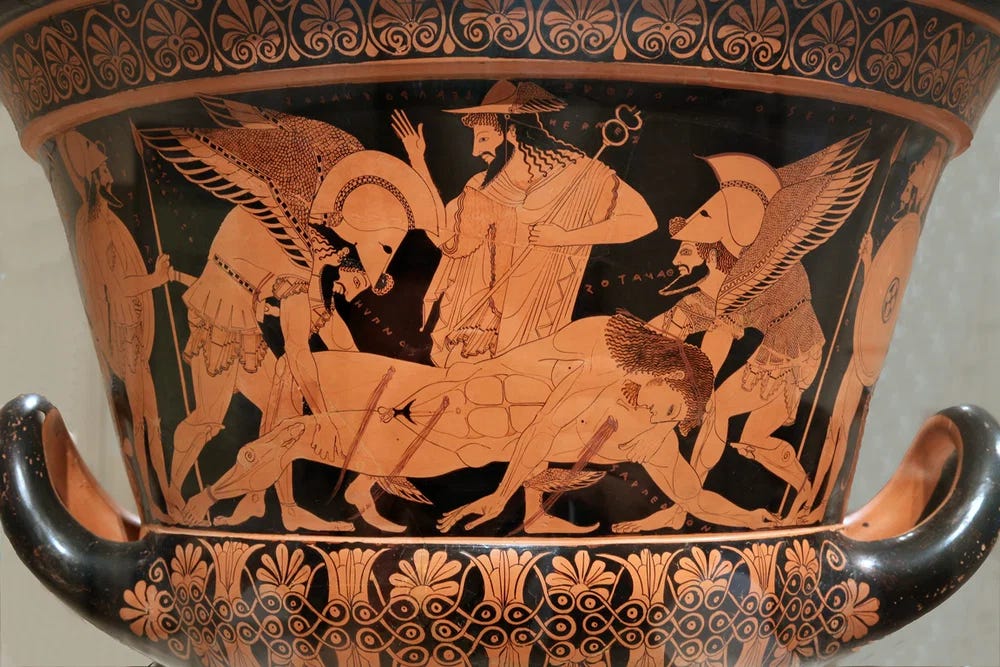
But what does it mean to have the gods and all of nature on our side? More life? Not necessarily! While the initiates do prize “longevity” (makroisi kronois zoes / μακροίσι χρόνοις ζωής), the hymns as a whole focus on the sacredness of both life and death. The very point of being initiated during life is to have a good afterlife.
My arms are over this child
Unlike the Orphics, we today live in a life-obsessed culture that too often sees death as an enemy. At the conclusion of the Orphic ritual, the initiates embrace their ultimate end like a friend.
But they have earned the right to do so. How? By invoking the previous 86 hymns! They have summoned the protection of countless gods, and they have bound many evils (for an example of apotropaic, evil-warding magic in the Orphic hymns, see Kristin Mathis’s writings on the hymn to Ares.)
Maybe the Orphics were onto something. Maybe the point of all ritual, ultimately, is so that we might greet death as a friend when our time comes. Or, that we might greet any ending in our life with a tranquil peace.
I got another text from my brother. “It’s going to be a tough stretch when Tess goes. I dread it.”
Negative emotions like dread are why we have magic. Why we mourn. Why we have ritual. Why we go to the beach.
These activities are apotropaic — they turn away evil. What is evil? (We only ask the big questions here.)
Evil is not negative emotions themselves — dread, fear, anxiety, anger, hate, sadness, shame. These are natural, not evil. Evil, on the other hand, is the forces that feed on those negative emotions and keep us stuck there. This negative stasis is against the will of Nature.
Evil is not negativity itself, for negativity is part of the balance of Nature. Evil is the stasis and inertia of negativity which destroys the cosmic harmony between dark and light. By Nature, opposing forces are supposed to co-exist in harmony. Evil is that which prevents dark from turning to light.
In my experience, the easiest way to become vulnerable to evil is to dwell on things outside the present moment — either past or future. Whether that looks like dreading the loss of an aging pet, or lamenting a love that could have been, evil feeds on keeping your energy stuck in any space-time that is not now.1 Being at the beach, a ritual repetition, helped keep my brother present. What ritual will you do to be present?
“Everything harmonizes with me, which is harmonious to you, O Universe. For me nothing is too early or too late if it is in due time for you. Everything is fruit to me that your seasons bring. O Nature: from you are all things, in you are all things, to you all things return.”
Marcus Aurelius, Meditations (IV.23)
Presence, after all, may be the greatest magic of them all. Because the truth is: when you are present, nothing is absent — even the ones you have lost.
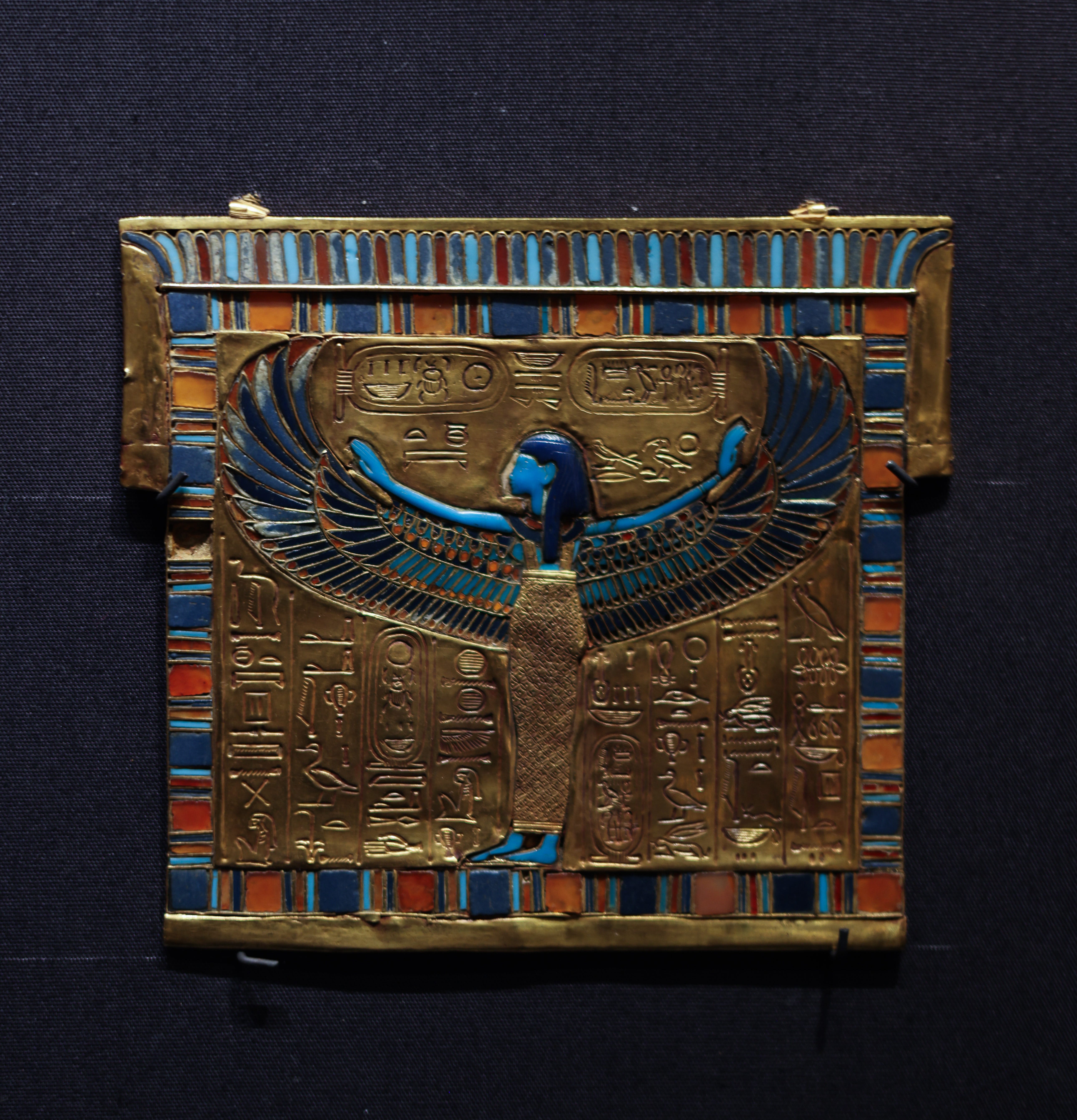
A doubtless influence on the Orphics, Ancient Egyptian religion is similarly preoccupied with spiritual protection in the afterlife. This preoccupation is perhaps best encapsulated in the figure of the goddess Isis. By reviving Osiris after his defeat at the hand of his evil brother, Set, Isis brings a darkened world back to light.
Isis is the great mother goddess and divine consort of Osiris. In Egyptian astronomy, Isis was associated with Sirius, the brightest star in the constellation Cannis Major (the Big Dog), and indeed, the brightest star in the whole night sky. Today Sirius sits in the middle degrees of tropical Cancer.
Sirius/Isis was also the most important star in the Egyptian calendar, as its summertime emergence before the dawn heralded the flood of the Nile, which brought life and fertility to the delta each year. In these ways we see Isis’s connection to the element of water.
Along with fertility and regeneration, mourning and protection in the afterlife are core themes of Isis. In the myth, Osiris is killed and his body dismembered by his evil brother, Set. Stricken with grief, Isis transforms into a bird to search for her husband’s scattered limbs. She retrieves and reassembles the body of Osiris, before using the magic of her mourning to revive him in the underworld. There, they unite once more and produce a son, Horus, who will avenge his father by destroying evil Set.
But while new life is given in the form of Horus, who rises as a new Sun, Osiris himself must remain in the realm of the dead. Isis’s loss cannot be undone, but her magic generates a new world.
The purpose of our rituals, our magic, and our protective offerings is not to prevent loss. It is to protect the promise of new life. That the light will return.
The water that remembers
I’m sure you can remember a time when you “believed” your life would get better if something or someone outside of you would change. This is how we forgot. Twisted by anxiety, by dread, by shallow hopes, or by shame, it became too easy to paint ourselves into the tiniest corner of the universe. Then we remembered to have mercy on our own souls, in all their magnificent color.
Suffering grows out of the merciless refusal to accept change — or simply accept people, places, things, and events just as they are in the present moment. We cannot prevent loss, but we can prevent suffering through this acceptance. Psychotherapist Carl J. Rogers put it this way: “The curious paradox is that when I accept myself just as I am, then I can change.”
Unhealed attachments to the past and anxious attachments to the future inevitably warp our sense of the good — keeping us stuck in the same old stories, and making us vessels for evil. But when we accept darkness and shadow, it loosens their hold over us. Cool water restores the body of Osiris, and we remember who we truly are.
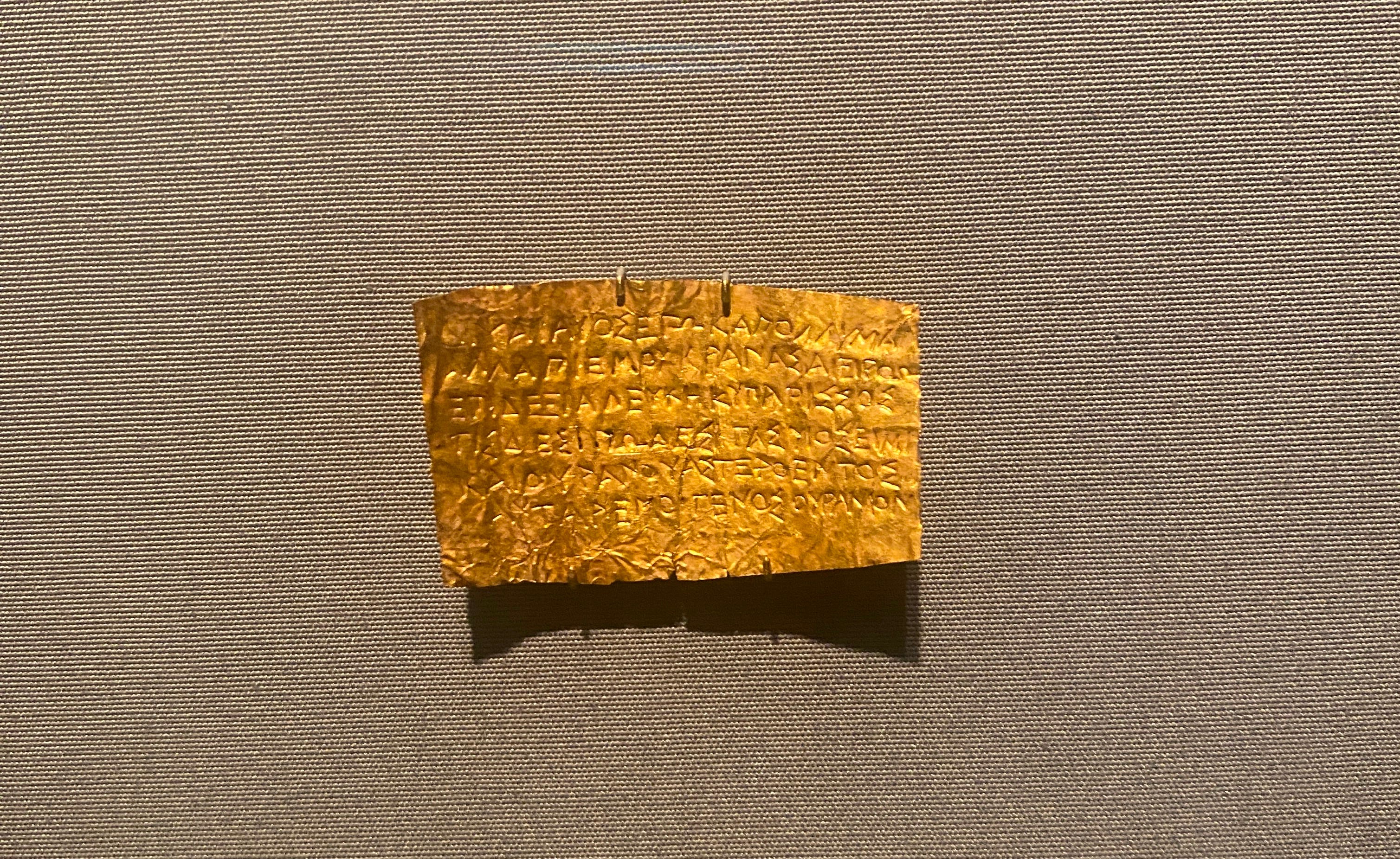
In Orphic mythology, memory and forgetting take the form of two separate bodies of water in the underworld. Our primary evidence comes from Orphic gold tablets — thin inscribed sheets buried with initiates as funerary objects — which provide step-by-step instructions for navigating the afterlife. In these texts, the initiate is told to avoid the river Lethe (forgetfulness) and instead seek out the pool of Mnemosyne (memory). By drinking the water of memory, the initiate would be able to return to the eternal Stars.
It is easy to see why the Orphics held Memory among their most sacred deities. For she held the keys of the eternal.
[Memory,] You exist eternally beyond evil,
mind-tangling Forgetfulness,
ever apart from the pernicious
river Lethe who misleads and disables.
Folding every mind into the chest,
uniting it there with the souls of fleshly beings,
you make the mind a housemate of the soul
Orphic Hymn of Mnemosyne, trans. Kristin Mathis
When the mind is a housemate of the soul, we need dwell in no other time but this one.
To conclude, I would wish to say a bit about what I even mean by eternal.2 However, as any initiate knows, it is the nature of the most sacred and holy things that they are unspeakable.
Maybe some other time.
For now,
Drew
P.S. Registration for our class on the Orphic hymns, Orphic cosmology, and the wisdom at the roots ancient astrology is open!
Learn more here: STAR: An Orphic Initiation
Yes, I do mean this as a caution to astrologers always looking to the future. Our sacred arts do not immunize us against evil.
My concept of eternity is most influenced by Presocratic philosophers like Heraclitus. Another important text dealing with eternity is Marcus Aurelius’s Meditations, particularly Book IV and Book IX.
One of the things I noticed last summer with this conjunction was myself/people around me feeling more weepy and sentimental. I was very suddenly in my feels about someone who'd died 4 years back who I hadn't been able to grieve properly until then. So this totally tracks. The getting emotionally unconstipated of it all.
Love this and your thinking, Drew. Here for the big questions. Thank you teasing them out with such skill 💕